St. George Villa
This project transformed a dark, damp basement flat in Walthamstow, into a light-filled home with an additional bedroom and expanded living space. A new extension, connected to the existing house by a glazed link, sits slightly apart from the original structure.
Dezeen Awards, finalist 2026
Architects Journal Small Projects Award, finalist 2026
Building Design One Off Small Project of the Year award, finalist 2026
The extension is timber-framed with high levels of wood fibre insulation and small pad foundations. A planted courtyard introduces daylight to the existing rooms, while a rear garden slopes down to floor-to-ceiling glazing that opens the living space to the outdoors.
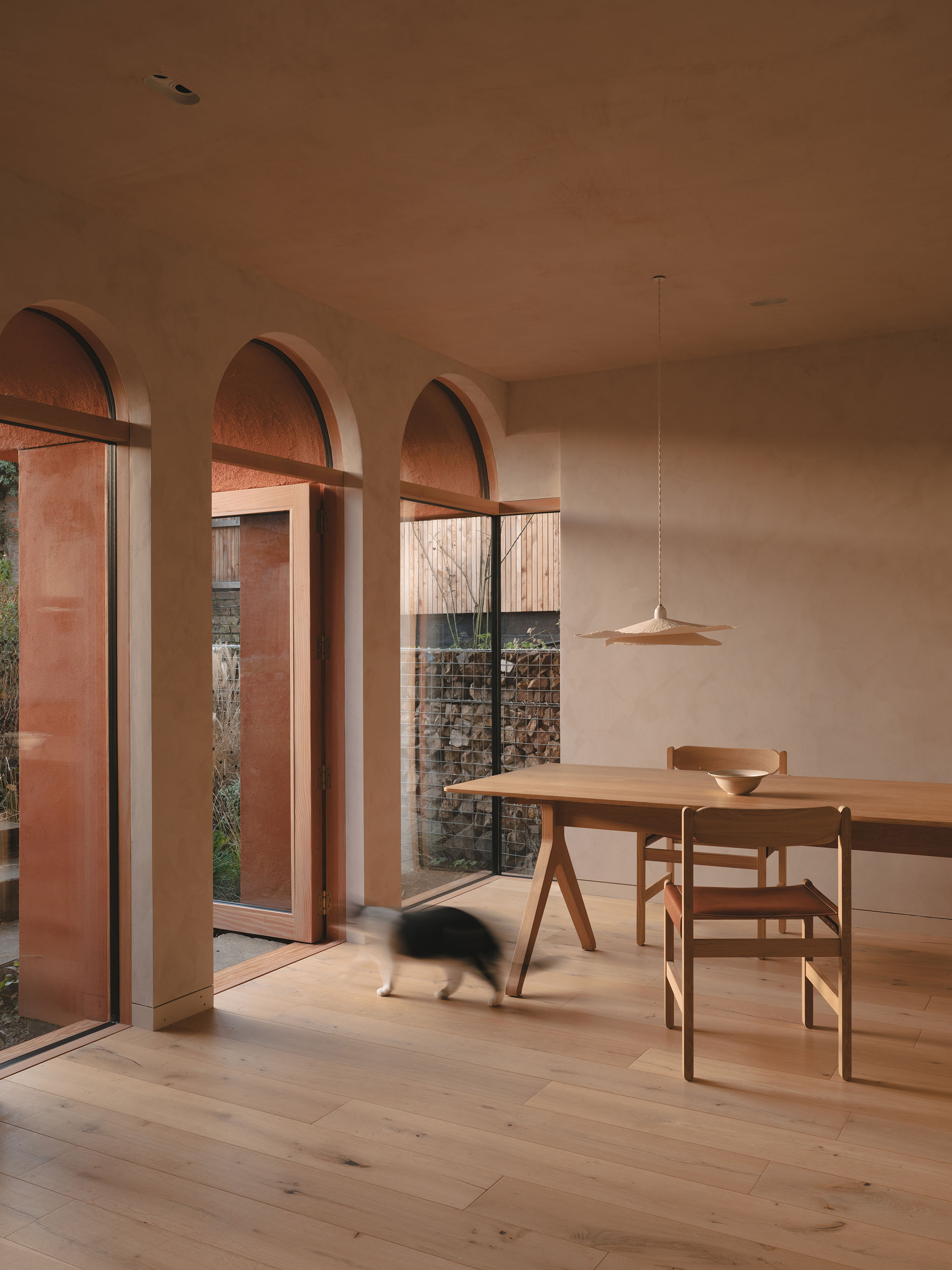
The south-facing elevation features a cantilevered roof that reduces overheating in summer while allowing passive solar gain in winter. Arched openings, inspired by those in the original building, give the extension a distinctive identity.
Material reuse was central to the design: joinery was made from reclaimed school lab benches, timber cladding came from a Higher-Risk Building, and insulation from a trade show stand. Almost all demolition waste was reused to form gabion retaining walls, diverting 24 tonnes from landfill.
The home is all-electric, using an air source heat pump, underfloor heating, MVHR, a green roof and rainwater harvesting for garden irrigation.
Working closely with the clients, this project has allowed us to test many new, low-carbon, construction materials and techniques.
Structures by Agnos Studio, photography by Peter Molloy & Studio Grieveson
WORK WITH US
Have a project in mind?
We enjoy the challenge of ambitious, sustainable briefs. Tell us about your site, your ideas and your timeline — we’d love to hear from you.

St. George Villa
This project transformed a dark, damp basement flat in Walthamstow, into a light-filled home with an additional bedroom and expanded living space. A new extension, connected to the existing house by a glazed link, sits slightly apart from the original structure.
Dezeen Awards, finalist 2026
Architects Journal Small Projects Award, finalist 2026
Building Design One Off Small Project of the Year award, finalist 2026
The extension is timber-framed with high levels of wood fibre insulation and small pad foundations. A planted courtyard introduces daylight to the existing rooms, while a rear garden slopes down to floor-to-ceiling glazing that opens the living space to the outdoors.
The south-facing elevation features a cantilevered roof that reduces overheating in summer while allowing passive solar gain in winter. Arched openings, inspired by those in the original building, give the extension a distinctive identity.
Material reuse was central to the design: joinery was made from reclaimed school lab benches, timber cladding came from a Higher-Risk Building, and insulation from a trade show stand. Almost all demolition waste was reused to form gabion retaining walls, diverting 24 tonnes from landfill.
The home is all-electric, using an air source heat pump, underfloor heating, MVHR, a green roof and rainwater harvesting for garden irrigation.
Working closely with the clients, this project has allowed us to test many new, low-carbon, construction materials and techniques.



Structures by Agnos Studio, photography by Peter Molloy & Studio Grieveson
Structures by Agnos Studio, photography by Peter Molloy & Studio Grieveson
